Table of Contents
- What Is a Project Management Methodology?
- Methodology vs. Framework: What’s the Difference?
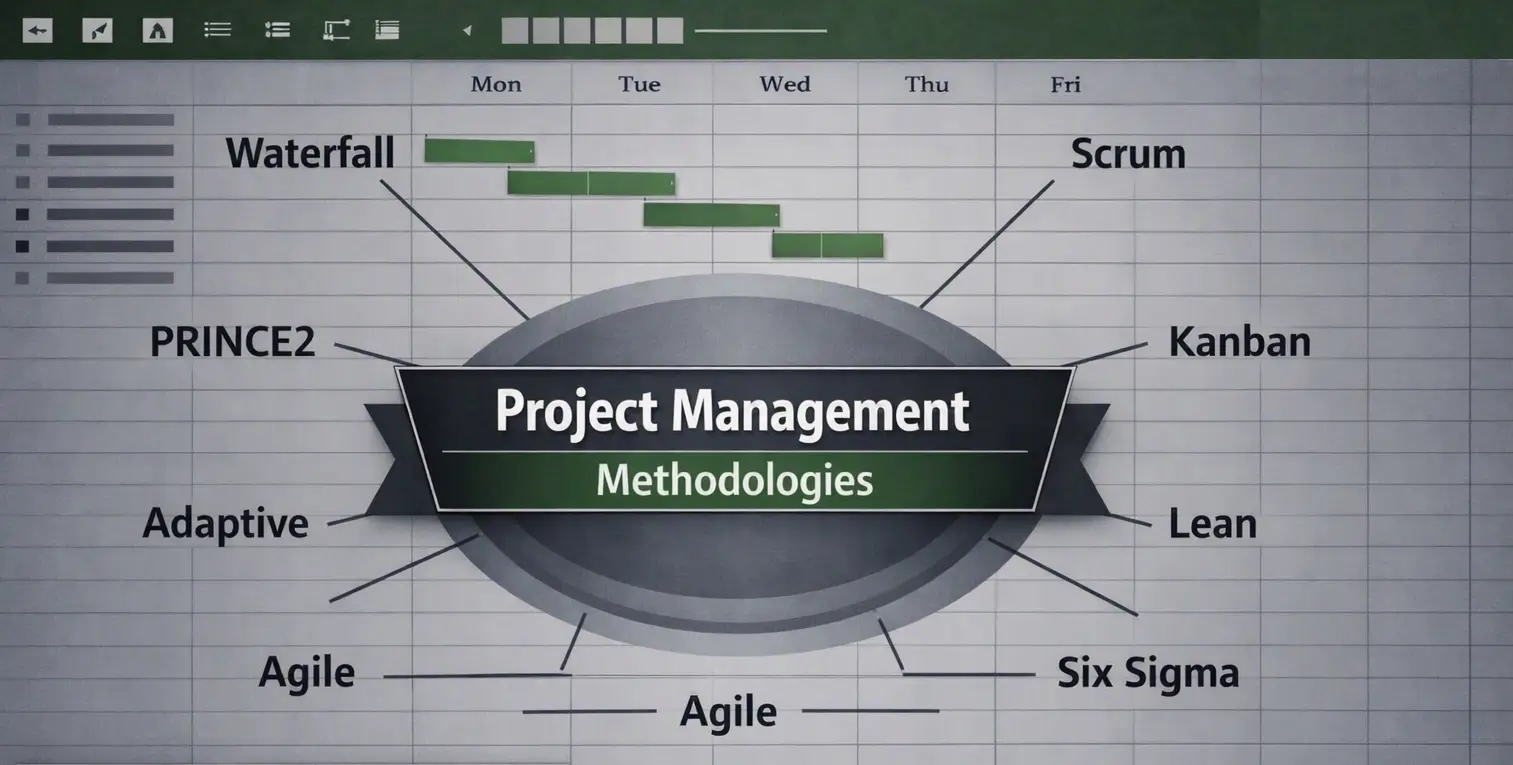
- Types of Project Management Methodologies
- Methodology Comparison: Best For and Limitations
- Project Management Methodology Examples
- How to Choose a Project Management Methodology
Show more ▾Show less ▴
A project management methodology is a defined set of principles, processes, and practices a team follows to plan, execute, and deliver a project from start to finish. It answers three practical questions: how work gets planned, how progress gets tracked, and how changes get handled along the way. Some methodologies, like Waterfall, assume the plan is locked in before work starts. Others, like Agile, assume the plan will change and build that flexibility in from the outset. Neither is universally “better”: the right project management methodology depends on the kind of work, the size and location of the team, and how much the requirements are likely to shift once work is underway.
This guide is written for people who manage projects for a living: project managers, PMO staff, and team leads deciding which methodology to use on a real project, or brushing up before a certification exam. It assumes you already know what a project is, but not that you’ve settled on a methodology yet. If you landed here for a school assignment on “project work methodology,” this page covers the professional, workplace meaning of the term rather than a coursework template.
Key Takeaways
- A project management methodology defines how a project is planned, executed, and controlled: it’s the underlying approach to decision-making, not just a checklist of steps.
- Methodologies fall into three broad families: traditional/predictive (Waterfall, PRINCE2, the Critical Path Method), Agile/adaptive (Scrum, Kanban, Extreme Programming), and hybrid approaches that combine both.
- There’s no single best project management methodology: the right choice depends on how fixed the requirements are, how large and distributed the team is, and how much oversight or compliance the work requires.
- Lean and Six Sigma aren’t full project management methodologies on their own: they’re process-improvement approaches most teams layer on top of a methodology like Waterfall or Agile.
- In practice, most teams run some version of a hybrid approach, even when they formally say they follow one named methodology.
- Want a quick reference you can keep? Grab the free one-page cheat sheet below, or test yourself with the short quiz further down the page.
What Is a Project Management Methodology?
At its simplest, a project management methodology is the rulebook a team agrees to follow for running a project. It covers how tasks get planned and sequenced, who has authority to sign off on decisions, how risk and scope changes get handled, and what counts as “done” at each stage. A methodology doesn’t just describe activities; it sets the order they happen in and the rules for moving from one to the next.
Choosing a methodology matters because it shapes almost everything downstream: how detailed the upfront plan needs to be, how often the team checks in with stakeholders, how change requests get approved, and how success gets measured at the end. A construction project and a software product team both need “a methodology,” but they rarely need the same one: one deals with physical, hard-to-reverse work where the plan has to be right before ground breaks, while the other deals with software that can be revised weekly based on user feedback.
The difference shows up in day-to-day decisions, not just in planning documents. On a fixed-methodology construction project, a change to the floor plan after the foundation is poured triggers a formal change order, a cost review, and often a delay, because the sequence of work assumes the plan won’t move. On a Scrum-run software team, a change to what a feature should do can be absorbed at the next sprint planning session, because the process was built expecting requirements to shift as users interact with early versions. Neither team is doing it wrong; they’re following a methodology suited to how reversible their work actually is.
Methodology vs. Framework: What’s the Difference?
The terms get used loosely, but there’s a real distinction. A methodology is prescriptive: it defines the specific steps, documents, and approval gates a team follows, in a set order. A framework is looser: it defines roles, principles, and recurring events, but leaves the specific day-to-day steps up to the team.
Scrum is the clearest example: it’s usually called a framework, not a methodology, because it defines roles (product owner, Scrum master, development team) and recurring events (sprint planning, daily stand-up, retrospective) without dictating exactly how the team should plan, estimate, or execute the work inside a sprint. PMBOK, by contrast, is a structured body of knowledge that many traditional methodologies draw their process groups and knowledge areas from; it’s a reference standard more than a single rigid methodology in itself. The practical takeaway: when a competitor or a certification body says “framework” instead of “methodology,” it usually means more room for the team to decide how the work actually gets done.
One more term worth separating out: a methodology is not the same as a single tool or technique. The Critical Path Method, for instance, is a scheduling technique, not a full methodology on its own; it’s typically used inside a broader methodology like Waterfall or PRINCE2 to work out the schedule, rather than replacing the methodology itself. The same is true of Lean and Six Sigma, covered below: both are process-improvement techniques that get layered onto a project management methodology, not stand-ins for one.
Types of Project Management Methodologies
Every named methodology fits into one of three broad families, based on how it handles a plan changing mid-project.
Traditional (Predictive) Methodologies
Traditional methodologies assume the full scope can be defined upfront and the plan should be followed closely once it’s approved. Work moves through fixed, sequential phases (typically initiation, planning, execution, monitoring, and closing), and changes to scope go through a formal approval process rather than being absorbed as they come up. Waterfall, PRINCE2, the Critical Path Method (CPM), and Critical Chain Project Management (CCPM) all fall into this family. Traditional methodologies tend to work best when the requirements are genuinely stable, the cost of change is high (construction, manufacturing, regulated industries), or a client or regulator requires a detailed plan and audit trail before work can start.
This family also tends to fit projects with a single, external client who wants a fixed-price contract based on a defined scope: a fixed plan makes it possible to quote a fixed price. Government contracting, large infrastructure builds, and enterprise system rollouts with a hard go-live date are typical examples, since all three need a documented plan stakeholders can sign off on before significant money gets committed.
Agile (Adaptive) Methodologies
Agile-family approaches assume the opposite: that requirements will change as the team learns more, and the process should make room for that rather than fight it. Work is broken into short cycles (sprints in Scrum, continuous flow in Kanban) with frequent check-ins, working increments delivered early, and priorities re-evaluated regularly instead of locked in at the start. Scrum, Kanban, and Extreme Programming (XP) are the most common Agile frameworks. This family tends to fit software development, product teams, and any project where user feedback should shape what gets built next, more than industries where the deliverable is physical and expensive to redo.
Marketing teams running iterative campaigns, product teams shipping features incrementally, and internal tooling teams responding to changing business needs all tend to gravitate toward Agile for the same reason: the cost of shipping something, learning it’s wrong, and adjusting is low compared to a construction project, so there’s little upside to locking in a detailed plan months in advance.
Hybrid Methodologies
A hybrid approach combines elements of both: for example, using a traditional, phase-gated structure for overall planning, budgeting, and stakeholder sign-off, while running the actual delivery work in Agile sprints. Hybrid approaches are common in larger organizations that need the predictability and reporting structure traditional methods provide at the portfolio level, but want their delivery teams to work iteratively. In practice, this is closer to how most real teams operate than a textbook-pure Waterfall or Scrum implementation, since few organizations run either extreme in its strict original form.
A common hybrid pattern in software and product organizations: the business case, budget, and overall timeline get approved through a Waterfall-style gate at the start, the delivery team runs Scrum sprints to actually build the product, and a final Waterfall-style acceptance and rollout phase closes the project. This gives finance and leadership the predictability they need to approve the budget, while the delivery team keeps the flexibility to adjust the plan as they learn what actually works.
Methodology Comparison: Best For and Limitations
| Methodology | Best For | Limitations |
|---|---|---|
| Waterfall | Projects with stable, well-understood requirements and a high cost of late changes (construction, manufacturing, compliance-heavy work) | Costly and slow to accommodate changes once a phase is signed off |
| PRINCE2 | Organizations that need a formal governance structure, clear roles, and audit trail across many projects | Heavier documentation overhead than most teams need for smaller projects |
| Scrum | Product and software teams that need to adapt priorities frequently based on user feedback | Needs a disciplined, dedicated team and stakeholder buy-in to work well; less suited to fixed-scope contracts |
| Kanban | Ongoing, continuous-flow work (support queues, maintenance, content pipelines) without fixed project end dates | Provides less structure for time-boxed, one-off projects with a hard deadline |
| Lean | Reducing waste and non-value-adding steps in an existing process | Not a full project management methodology on its own; usually paired with Agile or Waterfall |
| Six Sigma | Reducing defects and variability in repeatable, high-volume processes | Requires statistical/process-improvement expertise; overkill for one-off creative projects |
| Critical Chain (CCPM) | Resource-constrained projects where multiple projects compete for the same people or equipment | Requires accurate resource and duration estimates to work as designed |
Project Management Methodology Examples
The methodology families above are made up of specific, named approaches. Here’s what each one actually involves in practice.
Waterfall
The original sequential methodology: requirements, design, build, test, and deployment happen one after another, each phase completed and approved before the next begins. The project plan and the requirements document typically get signed off before any building work starts, and moving backward to an earlier phase once it’s closed is treated as an exception, not routine.
Best for: construction, manufacturing, and any project where the requirements are fixed and changes are expensive once work has started.
PRINCE2
A structured, process-driven methodology built around defined roles, stage boundaries, and a business case that gets revisited at every major decision point; widely used in the UK public sector and in large organizations that run many projects at once. Each stage ends with a formal review against the original business case, so a project that no longer makes sense can be stopped early rather than running to completion out of momentum.
Best for: organizations that need consistent governance and reporting across a large project portfolio, not just a single project.
Critical Path Method (CPM)
A scheduling technique that maps every task, its dependencies, and its duration to identify the longest sequence of dependent tasks: the “critical path” that determines the earliest possible finish date. Tasks on that path have zero slack; delaying any one of them delays the whole project, while tasks off the critical path have some buffer before they affect the finish date.
Best for: any project with many interdependent tasks where knowing exactly which delays would push back the deadline matters, construction and engineering projects especially.
Critical Chain Project Management (CCPM)
Builds on the Critical Path Method but adds buffers around resource constraints rather than individual task estimates, on the theory that people pad their own estimates and that padding gets wasted rather than protecting the schedule. Instead, CCPM strips the padding out of individual tasks and places a single shared buffer at the end of the chain, which tends to shorten the overall schedule while still protecting the final deadline.
Best for: organizations running multiple projects that share the same limited people or equipment.
Lean
A process-improvement approach focused on eliminating steps that don’t add value for the end customer, originally developed in manufacturing (Toyota’s production system) and since adapted to software and services. Common Lean tools include value stream mapping, which lays out every step in a process to spot delays and handoffs that don’t add value, and a bias toward small batches of work over large ones.
Best for: streamlining an existing, repeatable process, usually applied alongside a project management methodology rather than replacing one.
Six Sigma
A data-driven methodology for reducing defects and variability in a process, using the DMAIC cycle (Define, Measure, Analyze, Improve, Control) and statistical analysis to find root causes rather than symptoms. Practitioners are certified by “belt” level (Green Belt, Black Belt, Master Black Belt), reflecting how much statistical training and project-leadership experience they have, similar in spirit to how PMP or PRINCE2 certifications signal experience level in traditional project management.
Best for: high-volume, repeatable processes where consistency and defect reduction are the goal: manufacturing, healthcare operations, financial processing.
Scrum
An Agile framework that organizes work into fixed-length sprints (typically 1-4 weeks), with a product owner prioritizing the backlog, a Scrum master removing blockers, and the team committing to a set amount of work per sprint. Each sprint ends with a review of what was built and a retrospective on how the team worked, so the process itself gets adjusted alongside the product.
Best for: software and product teams that need to adapt to feedback quickly and release working increments on a regular cadence.
How to Choose a Project Management Methodology
Five questions narrow the choice down quickly:
- How stable are the requirements? If the scope is genuinely fixed and unlikely to change, a traditional methodology avoids the overhead of continuous re-planning. If requirements are likely to evolve as work progresses, an Agile framework absorbs that change instead of fighting it.
- How large and distributed is the team? Small, co-located teams can run lightweight Agile ceremonies easily; large, multi-vendor, or geographically spread teams often need the clearer governance and documentation a methodology like PRINCE2 provides.
- What are the compliance or regulatory demands? Regulated industries (healthcare, finance, government, construction) often require a documented audit trail and formal sign-offs that fit a traditional or hybrid approach better than a pure Agile process.
- How involved does the client or stakeholder need to be? If stakeholders want to see and react to work incrementally, Agile’s frequent check-ins fit naturally. If they expect a single detailed plan upfront and periodic status reports, a traditional methodology matches that expectation better.
- How mature is the organization’s own process? Teams new to formal project management often do better starting with a simpler, well-documented methodology (Kanban, or a light Waterfall structure) before adopting something that requires more discipline to run well, like Scrum or Six Sigma.
In practice, most organizations land on a hybrid: a traditional structure for budgeting, staffing, and stakeholder reporting, with delivery teams working in Agile sprints underneath it. That’s not a compromise so much as the realistic default, and it’s worth treating “which methodology” as a spectrum to land on, not a single label to pick once and never revisit.
Getting this right also depends on the team’s underlying project management skills and how well-defined stakeholder roles are going in: no methodology compensates for a team that hasn’t nailed down who has authority to make decisions.
A quick worked example: a mid-sized agency runs both client website builds and its own internal marketing campaigns. For the client builds, scope and price are usually fixed in a signed contract, so a Waterfall-leaning process with clear phase sign-offs protects both the agency and the client. For internal campaigns, priorities shift weekly based on performance data, so a lightweight Kanban board tracking work in progress fits better than a rigid phase gate. Same agency, same team, two different methodologies, because the underlying work behaves differently.
Practice: Test Yourself
Quick knowledge check
10 questions based on this guide: the three methodology families, methodology vs. framework, the comparison table, and how to choose the right one. Multiple choice, instant feedback per question, retakeable.
Quick Knowledge Check: PM Methodologies
10 questions based on this guide: the three methodology families, methodology vs. framework, the comparison table, and how to choose. Takes about 3 minutes.
FAQ
Waterfall plans the full project upfront and moves through fixed phases in sequence, with changes going through formal approval. Agile plans in short cycles, delivers working increments regularly, and expects priorities to shift as the team learns more. The core trade-off is predictability (Waterfall) versus adaptability (Agile).
Yes: this is what a hybrid approach is. It’s common to run traditional, phase-gated planning and governance at the program level while delivery teams work in Agile sprints, or to layer Lean or Six Sigma process-improvement techniques on top of either.
Kanban is usually the lowest-overhead starting point for a small team: it visualizes work in progress without requiring fixed sprint cycles or extensive documentation. Scrum works well too if the team can commit to its regular ceremonies.
Scrum is technically a framework, not a methodology: it defines roles and recurring events (sprint planning, daily stand-up, retrospective) but leaves the specific day-to-day steps up to the team, unlike a prescriptive methodology such as PRINCE2.
No methodology legally requires certification to use, but formal certifications (PMP for PMBOK-based practice, PRINCE2 Foundation/Practitioner, Certified ScrumMaster) are often required or preferred by employers and can help a team apply a methodology consistently rather than informally.
PRINCE2 is a methodology with a defined process and set of roles, more common outside the US, especially in the UK and government-adjacent work. PMBOK is a body of knowledge and standard that the PMP certification is based on, more common in North America, and less prescriptive about the exact steps to follow. Many project managers hold both; the choice often comes down to which one a region or industry expects rather than which is objectively superior.